Country: Zambia
Region: MbalaProcess: Washed
Varietal: Starmaya
Altitude: 1,600 metres above sea level This washed Starmaya comes from Mount Sunzu Coffee, a forward-thinking farm in northern Zambia at the base of the country’s highest mountain. Mount Sunzu is redefining what coffee farming can look like by combining quality production with climate-smart practices and long-term community investment.
115 hectares are under coffee, with 600 hectares of Miombo forest actively reforested as part of their commitment to environmental restoration. The farm uses solar-powered irrigation, processes coffee on-site using washed, honey and natural methods, and supports biodiversity through beekeeping.
Alongside its environmental goals, Mount Sunzu provides fair, year-round employment to over 120 local staff, plus seasonal work. Wages include pension, health insurance and accident cover.

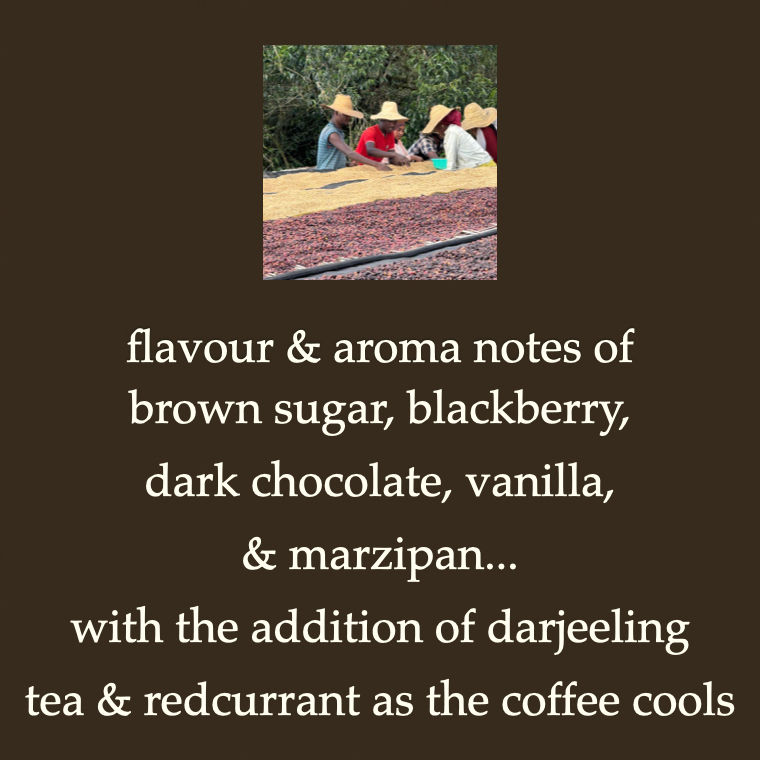
This coffee was processed entirely on-site at Mount Sunzu’s wet and dry mill. After careful picking, the ripe cherries were floated and pulped, then fermented for 24 hours in 1000ml tanks without water. Fermentation relied on naturally occurring yeast and bacteria to develop complexity and structure. The coffee was then dried over ten days on raised beds, which were covered at night to maintain consistency, before being hulled, graded and hand-sorted.


Starmaya ~ A Star Varietal
Varietals sit at the centre of how coffee evolves. They influence yield, cup profile, disease resistance, and how farms adapt to climate change. Most of the time they stay in the background - known mainly to agronomists and nurseries - but they shape everything we taste. When breeders make a breakthrough, the impact can ripple across entire producing regions. Starmaya is a modern F1 hybrid built to make advanced genetics accessible without lab propagation.

Starmaya is one of the most intriguing Arabica varieties of the past two decades. Built from a chance discovery - a male-sterile Arabica plant - researchers at CIRAD and ECOM turned that anomaly into the first F1 hybrid that can be grown from seed. It’s a breakthrough with major implications: higher yields, strong cup quality, and a production model accessible to smallholders because it avoids costly lab propagation.  Read on for an in-depth explanation of genetics, F1 hybrids, and the revolutionary Starmaya varietal…
Why coffee needs new genetics…
Coffee’s gene pool is worryingly narrow. Studies suggest that almost all Coffea arabica plants today trace back to a single ancestor that evolved around 10–20,000 years ago. This lack of diversity means the crop is extremely vulnerable - a single disease or climatic shock can wipe out production across entire regions.

Most farmers still save their own seeds to replant, a system that worked for decades but now struggles to withstand rising temperatures, erratic rainfall, and new pest pressures. Replanting the same genetics only repeats the same vulnerabilities. To stay profitable and resilient, farmers increasingly need plants with more adaptability built in. That’s where F1 hybrids come in.


What F1 hybrids are - and why they matter…
An F1 hybrid is the first generation of a cross between two genetically distinct parents. These plants combine the best traits of both lines and exhibit what’s known as hybrid vigour (heterosis) - faster growth, higher yields, and greater resilience to environmental stress.

F1 hybrids can outperform conventional varieties in nearly every way. They produce more cherry, show improved tolerance to diseases like leaf rust, and remain adaptable across diverse growing conditions. Crucially, they also maintain high cup quality - even scoring over 90 points in cupping evaluations.

Earlier breeding programmes often came with trade-offs: rust resistance at the cost of flavour, or high yield at the cost of quality. F1 hybrids are designed to eliminate those compromises - to deliver both productivity and quality in a single plant.


The challenge: why hybrids are still rare…
The science is promising, but F1 hybrids are expensive and difficult to mass-produce.

Traditionally, F1 coffee hybrids have only been reproduced through clonal propagation in labs, a slow and costly process. Fewer than a dozen labs in the world produce F1 coffee plants commercially, each making under one million seedlings a year - far below demand. These lab-grown hybrids can cost double the price of a conventional seedling, limiting access mainly to large farms or cooperatives.

Farmers also can’t save seed from an F1 plant. If they do, the next generation (F2) splits into unpredictable traits - tall and short, weak and strong, rust-resistant and rust-susceptible - losing the consistent performance of the F1. For now, farmers must buy true F1 plants from trusted nurseries.

A breakthrough: Starmaya…In 2001, researchers from CIRAD and ECOM found a rare male-sterile Arabica plant in the CATIE germplasm bank in Costa Rica. By crossing this plant with Marsellesa - a rust-resistant Sarchimor variety - they created Starmaya, the first Arabica F1 hybrid that can be reproduced by seed.

The key innovation lies in the male sterility. Because the mother plant produces no pollen, all the cherries it bears must be true hybrids fertilised by the pollen donor. This allows natural pollination in seed gardens, rather than costly lab propagation.

Starmaya combines the resilience and yield of Marsellesa with the quality potential of Ethiopian/Sudanese genetics. Field trials in Nicaragua found that Starmaya produced 30–47% more coffee than conventional varieties, with a high degree of uniformity and consistently strong cup scores.

A single hectare of Starmaya seed garden can generate enough seed for over 200 hectares of coffee, compared to just 15 hectares’ worth from a clonal propagation lab. The cost of seed production is also dramatically lower. It’s a scalable, affordable model that could finally bring F1 hybrids within reach for smallholders.


The bottom line…F1 hybrids are not a cure-all. They’re more expensive and require access to good nurseries, but they offer something traditional varieties no longer can - a path forward in a changing climate. These hybrids could “revolutionise the coffee industry through genetic progress, the way maize hybrids did in the last century”. The innovation of seed-propagated F1s like Starmaya makes that possibility real.
 Many thanks to the coffee farmers of the Mbala District, Mount Sunzu Coffee and Omwani for allowing me to use their excellent images